
Study Abroad from Sri Lanka · 18 Destinations · Free Counselling
Where in the world should you study?
Compare 18 destinations on the things that actually matter — tuition in LKR, post-study work, scholarships, and entry requirements. Then book a visit and sit down with a counsellor at any of our three offices. Free.
Not sure where to apply? Start here.
Pick what matters most to you. We’ll show you the destinations that fit, then a counsellor can narrow it to two or three when you visit.
Fastest, cheapest degree
Three-year Bachelor’s. Tuition-free public universities. Apply once, finish sooner.
Book a visit to discuss these event_availableBest path to PR
Two-year post-study work visas, points-based migration tracks.
Book a visit to discuss these event_availableGlobal top-ranked
Ivy League, Russell Group, Group of Eight — the brand-name route.
Book a visit to discuss these event_availableClose to home
Four hours from Colombo. UK and Australian degrees at branch campuses.
Book a visit to discuss these event_available Dubai
Dubai All 18 destinations, grouped by region
Tap a country for tuition in LKR, intake dates, visa requirements, and scholarships open to Sri Lankan students.
Europe & UK
Three-year degrees. Tuition-free public universities in Germany, France, and the Netherlands. The UK's two-year graduate route lets you work in London after you finish.
Study in
UK
Three-year Bachelor’s and one-year Master’s — one to two years shorter than the US or Canada. Russell Group degrees are recognised by employers everywhere, including back in Colombo, and the two-year Graduate Route lets you stay and work in the UK after you finish.

Study in
Germany
Public universities charge little to no tuition — even for non-EU students. Add the €11,904 Sperrkonto (released to you €992/month after arrival), 18 months to find work after graduation, and a job market starved for engineers, and Germany is the strongest value play in Western Europe.

Study in
Ireland
Trinity College Dublin, UCD and the new Technological Universities run entirely in English — no language pivot from a Sri Lankan A/L track. Combine that with the Third Level Graduate Programme (2 years post-study work for Master's, 1 for Bachelor's) and Europe's most active tech-and-pharma hiring market, and Ireland is the softest landing in the EU.

Study in
Netherlands
More than 2,100 Bachelor's and Master's programs run entirely in English — more than anywhere else on the continent. TU Delft, Utrecht, Amsterdam (UvA) and Eindhoven (TU/e) are research-led, problem-based, and globally ranked. Graduate, then take the Orientation Year — 12 months of unrestricted work rights to find a graduate job.

Study in
France
HEC Paris, INSEAD, Sciences Po, emlyon, ESSEC — France runs more of Europe's globally-ranked Grandes Écoles than any other country. The APS (Autorisation Provisoire de Séjour) gives Master's graduates 2 years to find work, and tuition at public universities runs €2,770–€3,770/year — a quarter of UK fees.

Study in
Switzerland
ETH Zurich (#7 in the world, QS 2025) and EPFL Lausanne (#26) are tied for the strongest engineering and CS in continental Europe. Add EHL, Glion and Les Roches — the three top-ranked hospitality schools globally — and Switzerland punches far above its size. Costs are high (CHF 21,000+/year living), but ETH/EPFL tuition is just CHF 1,460/year.

Study in
Italy
Bocconi sits in the top 10 globally for business; Politecnico Milano in the top 25 for engineering and design. Public university tuition (Sapienza, Bologna, Padova) runs €900–€4,000/year on the income-based ISEE scale. English-taught Master's are now widespread, and Italy offers a 12-month post-study residence permit.

Study in
Sweden
KTH (engineering), Karolinska (medicine), Lund, Uppsala and Stockholm University all rank in the QS top 200 and run extensive English-taught Master's. After graduation, you get a 12-month residence permit to find work. Swedish tech and pharma are deeply internationalised — Spotify, Klarna, AstraZeneca and Volvo hire English-speaking graduates routinely.

Study in
Finland
Aalto University, the University of Helsinki and Tampere all rank in the QS top 200 and run extensive English-taught Master's programs. After graduation you get a 2-year residence permit to find work in Finland's booming tech sector — Nokia, Supercell, Wolt and a dozen Helsinki startups hire Sri Lankan graduates routinely.

Study in
Austria
Austrian public universities charge non-EU students €726.72/semester — among the lowest tuition fees in the EU. TU Wien, the University of Vienna and WU Wien run dozens of English-taught Master's programs. After graduation, the Job-Seeker visa gives you 12 months to find work, with conversion to the Red-White-Red Card for skilled employment.

Study in
Malta
Malta is the EU's lesser-known English-medium destination — every degree at the University of Malta and MCAST runs in English, tuition is €1,080–€11,000/year, and living costs are 30–40% below Dublin or Amsterdam. After graduation you get a 9-month job-search residence permit and full EU work mobility.
Americas
World top-20 universities, the biggest scholarship pools, and OPT/PGWP work pathways that lead to long-term migration. The long game.

Study in
USA
15 of the world's top 20 universities are American — and US institutions hand out more financial aid to international students than every other country combined. Top schools routinely fund Sri Lankan undergraduates and PhD students at 80–100%.

Study in
Canada
IRCC closed the Student Direct Stream in November 2024, so Sri Lankan applications now go through the standard study permit route — typically 8 to 16 weeks. What has not changed is what makes Canada worth the wait: a 3-year Post-Graduation Work Permit and one of the clearest residency pathways of any major destination.
Asia-Pacific
Permanent residency on the table, short flights from Colombo, and a Sri Lankan community already in place. Australia and New Zealand lead, Singapore and Korea catching up fast.
Study in
Australia
Earn a Group of Eight degree, then stay on a 2–4 year Temporary Graduate visa and qualify for permanent residency through skilled migration. Sri Lankan students have a strong track record on this pathway.
Study in
New Zealand
All 8 New Zealand universities sit in the global top 3% — combined with a 3-year Post-Study Work Visa, smaller cohorts (less competition), and one of the friendliest residency pathways anywhere. The trade-off: a smaller graduate job market than Australia.
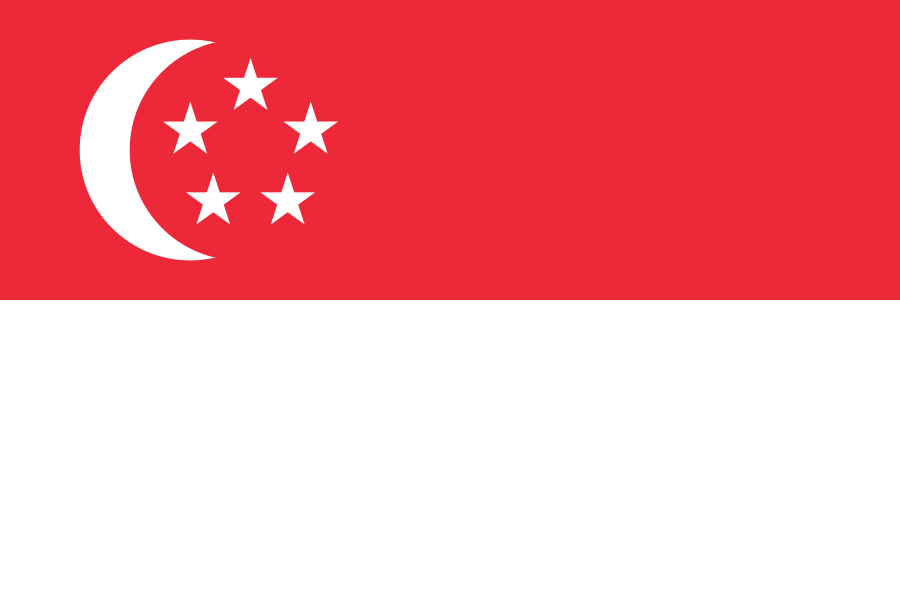
Study in
Singapore
NUS and NTU both rank in the global top 20 — ahead of most Ivy League and Russell Group institutions. The MOE Tuition Grant cuts your fees by up to 75%, and the Singapore graduate job market pays Western salaries in tax-friendly Asia.

Study in
South Korea
KAIST, Seoul National, Yonsei and Korea University all rank in the global top 100 — and the Global Korea Scholarship (GKS) covers tuition, living stipend, flights and Korean language training for selected international students. Sri Lankan applicants have a strong track record at GKS.
Middle East
UK and Australian degrees from branch campuses in Dubai — same accreditation, tax-free salaries after graduation, four hours from home.
How we make money
Why we don’t charge you a cent
Most Sri Lankan agencies charge LKR 50,000 to 500,000 upfront — sometimes more. We charge nothing.
When you enrol at one of our partner universities, they pay us a referral commission. The same way universities pay every recruitment agent worldwide. You pay tuition to the university, visa fees to the embassy, and zero rupees to Lanka Scholar. That’s it.
No consultation fees. No application fees. No SOP fees. No visa-prep fees. Ever.
What happens after you book a visit
The whole process, from first office visit to boarding pass. We do the heavy lifting at every step.
01
Book an office visit
Pick a branch, day and time — Rajagiriya, Jaffna, or Matara — and bring your A/L results, O/L results, or degree transcripts. Every consultation is face to face.
02
We shortlist 3–5 universities
Across the destinations you’re open to, matched to your grades, budget, and career goals.
03
We handle the paperwork
Applications, SOP, transcripts, visa documents, interview prep — every step.
04
You fly out
Pre-departure briefing, forex setup, accommodation tips. Then we stay in touch while you settle in.
Common questions
Can’t see your question? Book an office visit and ask a counsellor in person.
-
What does it cost? expand_more
Nothing. Lanka Scholar is free for students — universities pay us a commission when you enrol. The only money you send goes to the university (tuition) and the embassy (visa fees). -
Which destination is right for me? expand_more
Depends on your grades, budget, and what you want after graduation. One in-person consultation at any of our three offices usually narrows 18 destinations to two. -
Do I need IELTS or PTE? expand_more
For most destinations, yes. We help you book and prep — and advise on alternatives like the Duolingo English Test for universities that accept it. -
How long does the process take? expand_more
Application: 4–8 weeks. Visa: 4–12 weeks depending on destination. Start 6–12 months before the intake you’re targeting. -
Can I apply for a Master’s or PhD? expand_more
Yes. We work with Bachelor’s, Master’s, and PhD applicants across all 18 destinations. -
Where are your offices? expand_more
Rajagiriya (head office), Jaffna and Matara. Book a visit online and pick the branch, day and time that suits you. Every consultation is in person — we don't do phone or online consultations. -
Do you help with scholarships? expand_more
Yes — finding and applying for scholarships is part of the free service. See active scholarships open to Sri Lankan students on our scholarships page.
Further reading on studying abroad
Process, money and destination guides from our counsellor team — written for Sri Lankan students.
- Student Life·8 min read
Landing Your First Part-Time Job Abroad: A Practical Guide
How Sri Lankan students find a part-time job abroad: a local-format CV, the tax number you need first, where to apply, and staying within visa conditions.
Read the guide arrow_forward - Student Life·6 min read
Mental health & wellbeing support at universities abroad: a Sri Lankan guide
The free mental-health support universities abroad offer Sri Lankan students: counselling, GPs, disability services, crisis lines and when to reach out.
Read the guide arrow_forward - University Guides·6 min read
How to email a potential PhD supervisor: a guide for Sri Lankan students
How Sri Lankan students write an email to a potential PhD supervisor that gets a reply: what to include, what to avoid, and a structure that works.
Read the guide arrow_forward - Visa Advice·6 min read
Travelling home & re-entering on your student visa: a Sri Lankan guide
Can you visit Sri Lanka in the holidays and return on your student visa? The documents you need to re-enter safely and the traps that get students stopped.
Read the guide arrow_forward - University Guides·6 min read
Taught vs research master's (MRes/MPhil): which should you choose?
Taught MSc or MA versus research MRes or MPhil: how Sri Lankan students choose based on PhD plans, funding and career goals, and what each involves.
Read the guide arrow_forward - University Guides·8 min read
How to write a PhD research proposal: a guide for Sri Lankan students
How Sri Lankan students structure a PhD research proposal: the research question, literature gap and methodology, plus the mistakes that sink applications.
Read the guide arrow_forward
Still deciding? That’s exactly when to talk to us.
One visit to any of our three offices is usually enough to go from 18 destinations to two. No fee. No commitment. Free for students — universities pay us, not you.
Book your free office visit event_available- check_circle Consultations are in person only — no phone or online sessions
- check_circle Choose any of 3 offices across Sri Lanka
- check_circle Bachelor’s · Master’s · PhD — all 18 destinations
Book your office visit
verified100% free for students. Universities pay us, not you. How?
Every consultation happens face to face with a counsellor. We don't do phone or online consultations — pick a branch, day and time that suits you.
- location_on Rajagiriya (head office) 8th Floor, Jana Jaya City Mall, Rajagiriya, Sri Lanka
- location_on Jaffna 158 Hospital Road, Jaffna, Sri Lanka
- location_on Matara No. 474 New Tangalle Road, Matara, Sri Lanka
schedule Mon – Fri: 9:00 AM – 5:30 PM · Sat: 9:00 AM – 1:00 PM
Choose a date & time event_available